
Before ordering on JoyaGoo: items, sellers, sites and agents
The judgement calls that come before any parcel exists: reading a listing properly, weighing up a seller, deciding whether an agent deserves your money, and the things worth settling before you pay.
Reading a listing before it reaches the cart
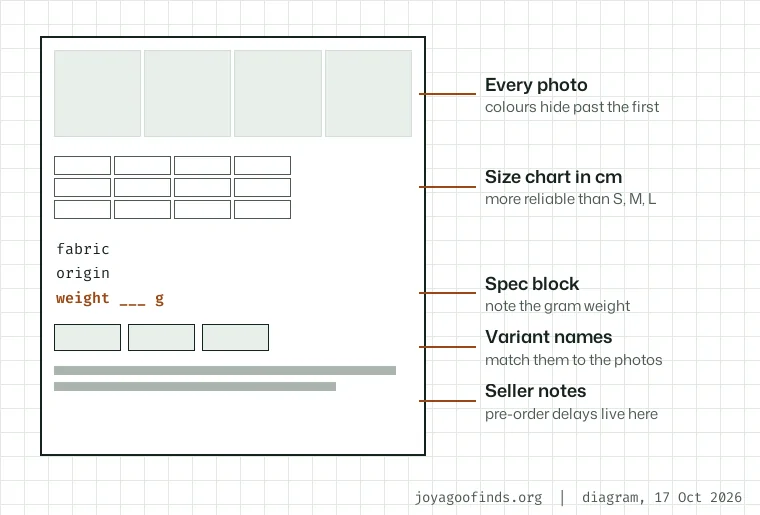
How to choose a product from a listing starts with the parts most people skip. The size chart comes first: letter sizes vary by seller and garment; compare the chart in centimetres with a similar item that fits. Then the specification block, which on many listings gives fabric, origin and, usefully for this site, an item weight in grams.
Look at every photo, not just the first. Sellers often show one colour in the hero image and others further down, and the variant names in the selector do not always match the photos. Read the seller notes too; that is where pre-order delays and stock caveats usually hide.
Write down the item weight if it is listed. It will not be the parcel weight, because the warehouse weighs what it packs, but adding the weights of everything you plan to send gives you a first figure for the grid position finder.
Choosing a seller: check their track record
Judging a seller means reading the marketplace's own signals rather than anything a catalogue adds. How long has the shop been open? What rating does the marketplace give it, and on how many sales? A new shop with one listing and no history is a bigger gamble than an established one, however good the photos look.
A logo alone does not establish authenticity or counterfeiting. Check the seller’s evidence and product description; JoyaGoo prohibits counterfeit purchases and its visual QC cannot authenticate a product.
If you have a question about sizing or stock, JoyaGoo can pass it to the seller before buying. A seller who answers clearly is a better sign than any rating.
What makes an agent worth trusting with money
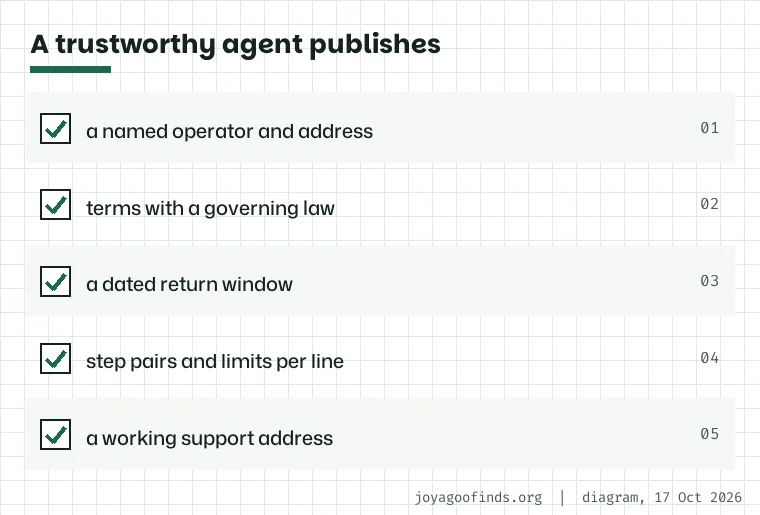
What makes a trustworthy agent is what it is willing to put in writing. A named operator with an address. Terms of service that say which law applies. A return window with a clear start and end. Shipping rules you can read before paying, including first weights, steps and limits for each line. And published support channels with a clear scope.
JoyaGoo publishes all five: the operator on its Contact Us page, terms governed by UK law, a five-day return window counted from QC completed, a public estimator with every line's step pair, and a support email and chat. That does not make it the right agent for everyone; it makes it checkable.
Be wary of agents, or catalogue sites, that answer these questions with ratings and slogans instead. A star score is not a return policy.
Things to settle before paying
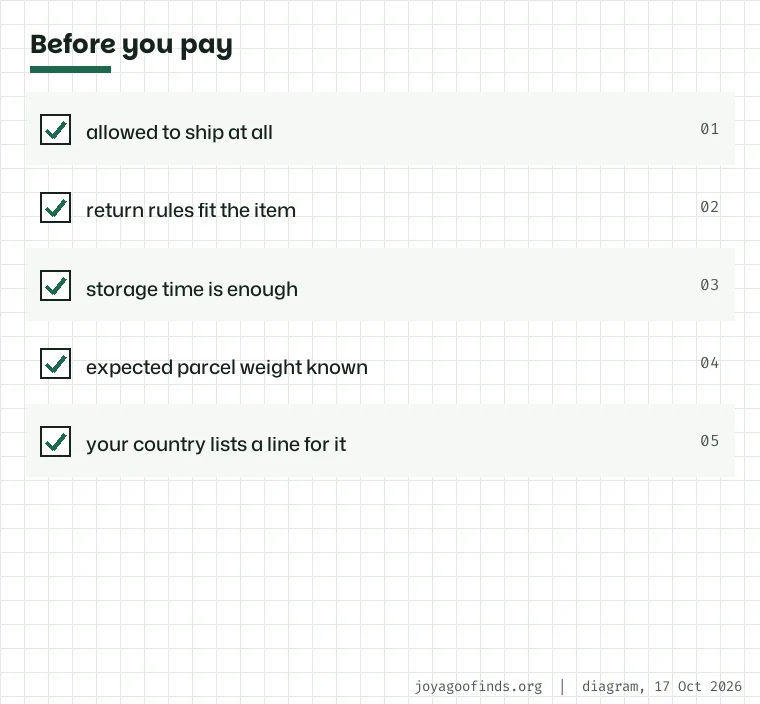
- Is it allowed to ship? The prohibited items statement lists goods JoyaGoo will not handle, from counterfeits to many liquids and batteries. Check before buying, not after the item reaches the warehouse.
- Do the return rules suit it? Five days after QC completed, seller consent required, and some categories excluded. Avoid buying something you are unsure about if it falls in an excluded category.
- Is storage long enough? Ninety days free from Stored. If you plan to wait for more items, count the days.
- Where will the parcel weight land? A rough parcel weight and the finder tell you whether you are just over an edge.
- Does your destination list a line for it? Some destinations in the dated sample saw only a small choice of line families; the step pairs page shows which pairs each country sees.
Things to avoid: paying before checking the prohibited list, asking for packaging to be removed from an item you might return, and treating a catalogue card as proof the listing still exists.
Reserve a second-stage budget
The first checkout concerns products, domestic delivery and the applicable purchase costs. International freight comes later for your chosen parcel. Include payment conversion, requested services and applicable destination charges when judging whether the purchase remains worthwhile. The cheapest catalogue item is not necessarily the cheapest item delivered to your address.
Compare a combined parcel and separate parcels when the contents or packing make that meaningful. Keep the route, weight basis, first increment and later increments attached to each estimate. If a deposit is adjusted after weighing, compare the final record with those inputs. The grid explains how a quoted tariff behaves; it cannot supply missing dimensions or turn a dated route example into an offer for a different basket.