
Below the first step: the minimum billable weight on JoyaGoo lines
Light parcels are billed at the first weight of their line, whatever they weigh. On most JoyaGoo lines that floor is half a kilo; on a few it is far lower, and on one line nothing under half a kilo is priced at all.
The floor on each pair
Everything at or below a line's first weight bills the first weight. A 120 g parcel and a 480 g parcel cost the same weight on a line whose first weight is 500 g, because both sit on the floor.
| Pair or line | Floor (g) | Applies to | Note |
|---|---|---|---|
| 500 / 200, 500 / 500, 500 / 100 | 500 | 23 line names | CH-DPD lines included |
| 200 / 20 (PostNL-Z-T) | 200 | 1 line name | then 20 g steps |
| 100 / 10 (EUB) | 100 | 1 line name | then 10 g steps |
| CA-air-P(Act weight) | 400 | up to 400 g | 500 from 401 g |
| CA-air-MG(Act weight) | 450 | up to 450 g | 500 from 451 g |
| 1,000 / 1,000 (CD-AIR) | 1,000 | from 501 g | not priced below |
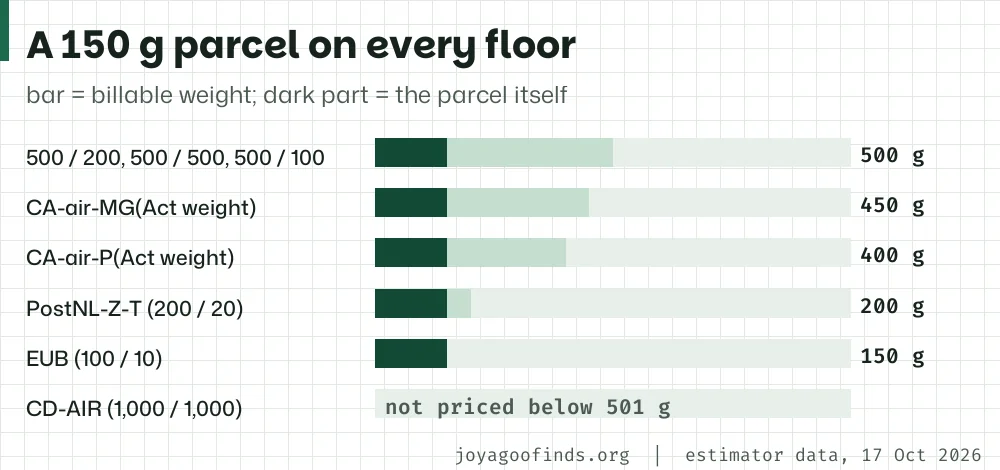
So the floor is the single biggest rounding a small parcel can meet. A 150 g parcel on a 500 g floor is billed more than three times its weight; the same parcel on EUB is billed 150 g.
Light parcels on the Canadian air lines
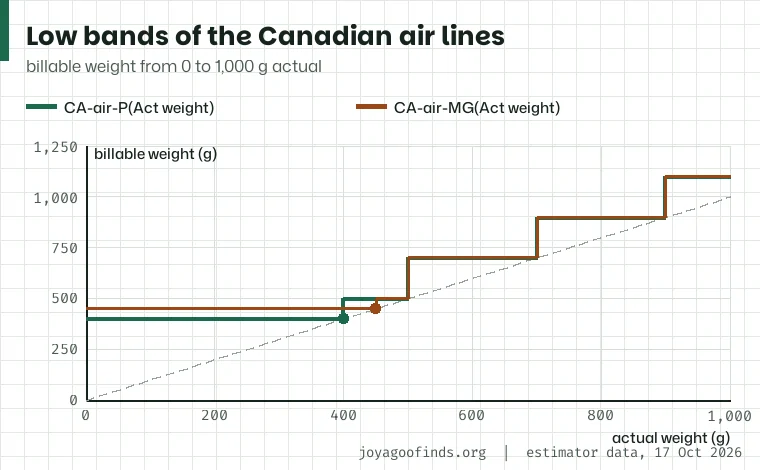
The two Canadian air lines are the only ones whose floor sits below half a kilo without switching to a fine step. CA-air-P(Act weight) bills 400 g for anything up to 400 g; CA-air-MG(Act weight) bills 450 g up to 450 g. Both then jump to the common pair: 401 g bills 500 g on the first, 451 g bills 500 g on the second.
In those low bands the estimator reports a continued step of 100 g, but it never comes into play: the band ends at the first weight, so every weight in it bills the floor. The Detail panel still shows it, as a price “per 100g” next to a first-weight price “per 400g” or “per 450g”.
Canada also lists EMS-60, which keeps its half-kilo floor. For a light parcel to Canada that makes three different floors on offer: 400 g, 450 g and 500 g.
Where CD-AIR starts pricing
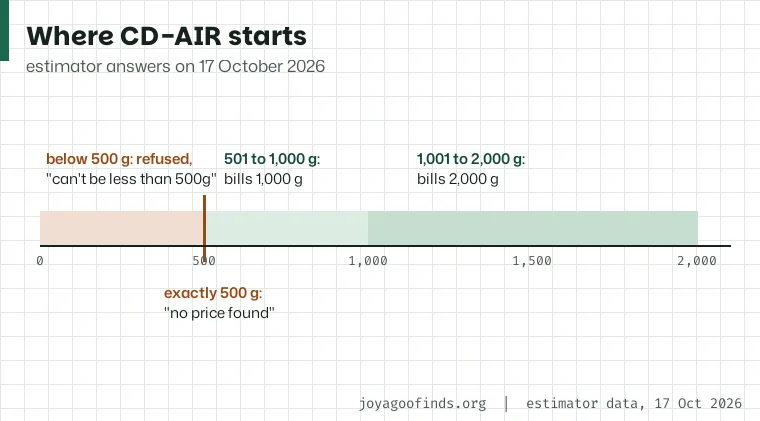
CD-AIR does not have a floor so much as a door. Below 500 g the estimator listed it as unavailable with the message “Package weight can't be less than 500g”. At exactly 500 g it was still unavailable, but with a different message: no price found for this weight range.
From 501 g it is priced, and its first weight is a full 1,000 g. So the lightest parcel it accepts is billed at nearly twice its weight, and anything up to 1,000 g bills the same kilo.
We report this as the estimator showed it and draw no conclusion about why the two messages differ. If you are near the bottom of its range, check the line on the official estimator before choosing it.
The most a single step can add
Above the first weight, the worst a step can do is add one gram less than its size: a parcel one gram past an edge pays for the whole next step. Below the first weight, the floor can add more.
| Pair | Largest overshoot above the first weight (g) | Largest overshoot on the floor (g) |
|---|---|---|
| 500 / 200 g | 199 | 499 |
| 500 / 500 g | 499 | 499 |
| 500 / 100 g | 99 | 499 |
| 200 / 20 g | 19 | 199 |
| 100 / 10 g | 9 | 99 |
| 1,000 / 1,000 g | 999 | 499 (from 501 g) |
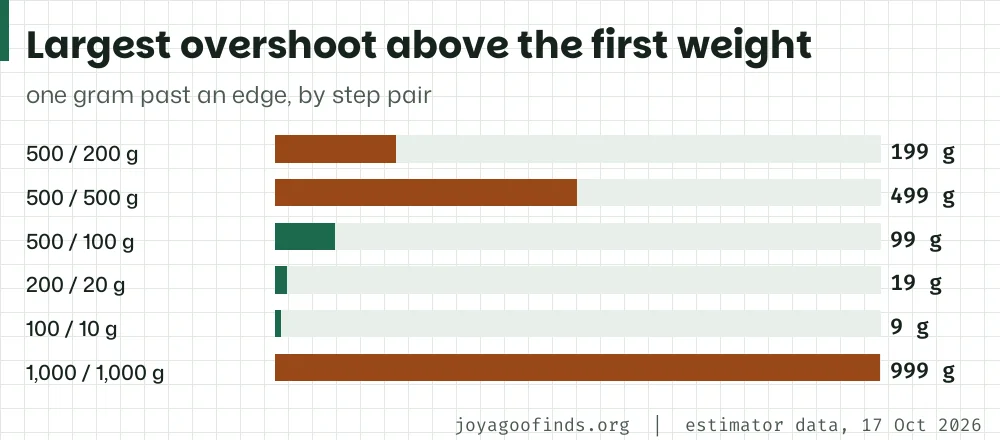
Those maxima only happen one gram past an edge. Most parcels land somewhere in the middle of a step, which is what the average in the next section measures.
Average overshoot by pair
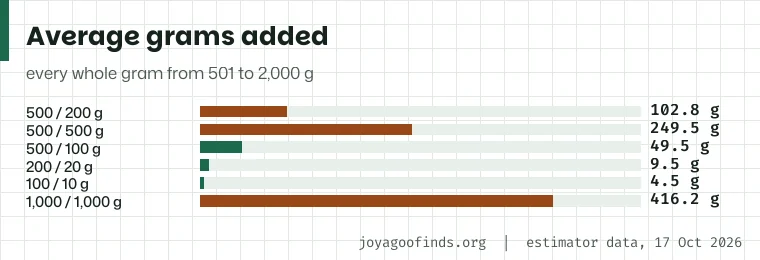
If every whole-gram weight between 501 g and 2,000 g were equally likely, the average overshoot on each pair would be roughly half its step. We worked it out exactly for that range, and the table under the chart gives the figures.
The share figure divides each average by the middle of the range, 1,250 g, to give a sense of scale. Real parcels are not spread evenly, so treat these as a description of the rules, not a forecast for your parcel.
| Pair | Average added (g) | Share of the mid-range weight |
|---|---|---|
| 500 / 200 g | 102.8 | 8.2% |
| 500 / 500 g | 249.5 | 20.0% |
| 500 / 100 g | 49.5 | 4.0% |
| 200 / 20 g | 9.5 | 0.8% |
| 100 / 10 g | 4.5 | 0.4% |
| 1,000 / 1,000 g | 416.2 | 33.3% |