
Step pairs on JoyaGoo shipping lines, from ten grams to a whole kilo
Every JoyaGoo line rounds weight with two numbers: a first block and the steps after it. Here are the six pairs in use on 17 October 2026, the 28 line names behind them, and which destinations see which.
The six pairs at a glance
A step pair is written first weight / continued weight. The first number is the smallest billable weight; the second is the size of every step above it. A parcel is always billed at the top of the step it falls into.
| Pair | Billable weights it can produce | Largest overshoot | Line names |
|---|---|---|---|
| 500 / 200 g | 500, 700, 900, 1,100 ... (odd hundreds) | 199 g | 20 |
| 500 / 500 g | 500, 1,000, 1,500 ... | 499 g | 4 |
| 500 / 100 g | 500, 600, 700 ... | 99 g | 1 |
| 200 / 20 g | 200, 220, 240 ... | 19 g | 1 |
| 100 / 10 g | 100, 110, 120 ... | 9 g | 1 |
| 1,000 / 1,000 g | 1,000, 2,000, 3,000 ... | 999 g | 1 |
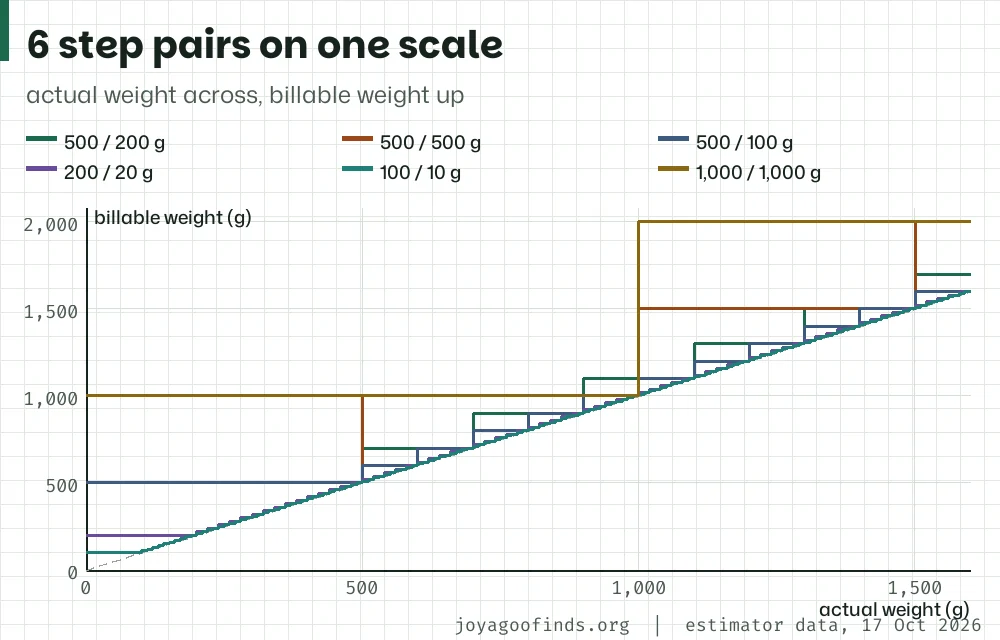
The pairs are read from the estimator's data fields for first and continued weight, not inferred from prices. Each one was confirmed by the billable weights the estimator returned at 47 sampled weights.
Five hundred, then two hundred: the common pair
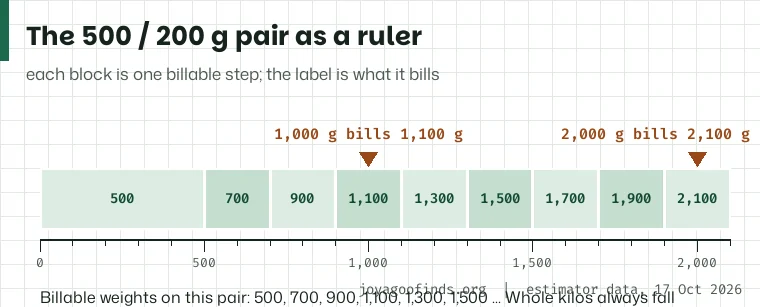
20 of the 28 line names use 500 / 200 at one kilo: the six DHL air lines sold in eleven European destinations, the three UK lines, the three US air and dedicated lines, three Australian lines, PostNL-B, and the four lines that change bands. It is the pair you are most likely to meet.
Its billable weights are always an odd number of hundreds: 500, 700, 900, 1,100. That is why every even hundred above 500 g, including every whole kilo, is billed 100 g higher than it weighs. The largest overshoot on this pair is 199 g, at 501 g, which bills 700 g.
- DHL:
DHL-air-DD(Tax Free),DHL-air-DDbig(Tax Free),DHL-air-Fh,DHL-air-Fhbig,DHL-air-MGbig,DHL-air-TM - United Kingdom:
UK-RoyalMail-P,UK-RM-F,UK Line-MG - United States:
US-air-F,US-MG-Y,US-MG-H - Australia:
XJ Australia Line-Bags,AU-FD-Z(actual weight),AU-F-Z(actual weight) - Band-switching, in this pair at one kilo:
CA-air-P(Act weight),CA-air-MG(Act weight),CH-DPD-F,CH-DPD-P
Half-kilo steps on the EMS lines
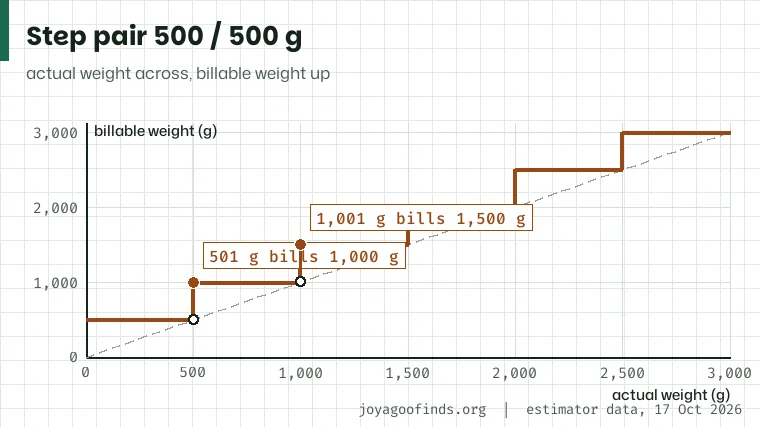
EMS-40, EMS-60, EMS-US and DPEX-D-T step in half kilos. Every multiple of 500 g is billable as it stands, so one kilo, two kilos and every whole kilo bill exactly. The price for that tidiness is a coarse step: 501 g bills 1,000 g, and 1,001 g bills 1,500 g.
On this pair the overshoot can reach 499 g, two and a half times the worst case on the common pair. Whether that matters depends entirely on where your weight lands inside the half kilo.
DPEX-D-T is the odd one out: it is the only line in this pair whose priced range stopped at 5,000 g in our sampling, although its stated limit is 15,000 g.
Fine steps of twenty grams and ten grams
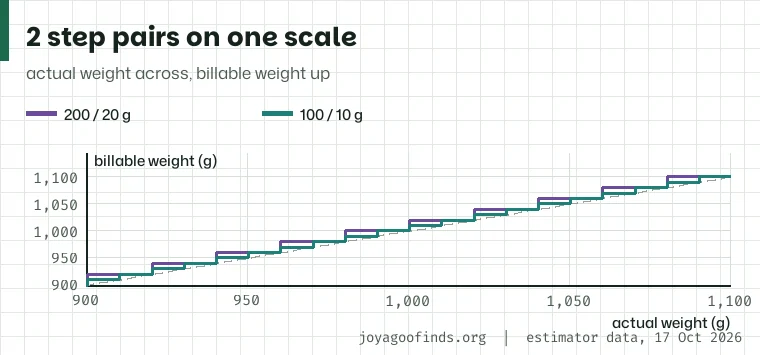
Two postal lines round in small steps. PostNL-Z-T starts at 200 g and climbs in steps of 20 g; EUB starts at 100 g and climbs in steps of 10 g. Neither can add more than 19 g or 9 g respectively above its first weight.
Both stop at 2,000 g. In our readings both were still returned above that weight, marked unavailable with the reason “Package weight can't exceed 2,000g”.
PostNL-Z-T appeared in 18 of our 22 destinations and EUB in 8, which makes the fine steps more common than the line count suggests.
Hundred-gram steps after the first half kilo
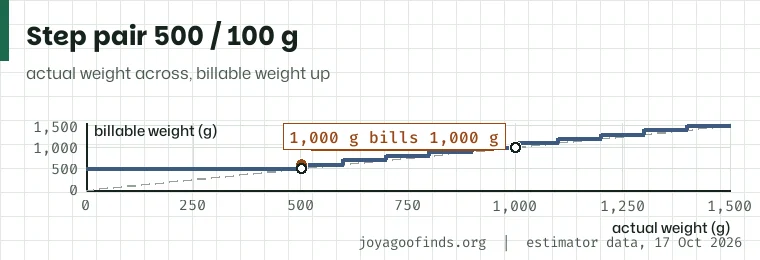
eEms combines a half-kilo first weight with 100 g steps. Anything up to 500 g bills 500 g; above that, the billable weight is the next whole hundred. One kilo bills one kilo, and 1,001 g bills 1,100 g.
It was offered in 8 of our 22 destinations: the seven that list CD-AIR, plus New Zealand. Its priced range ran to the highest weight we sampled for it, 28,000 g.
Whole-kilo steps on CD-AIR
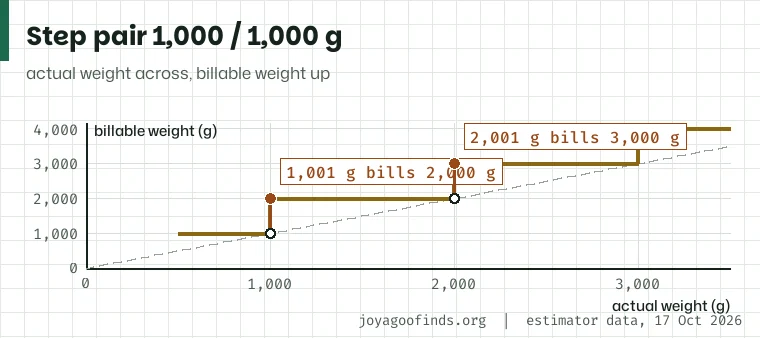
CD-AIR is the coarsest line in the data: a first weight of 1,000 g and steps of 1,000 g. A parcel of 1,001 g bills two kilos; one of 2,001 g bills three. The overshoot can reach 999 g.
It is also the only line with a floor below which it is not priced at all. Under 500 g the estimator marked it unavailable with “Package weight can't be less than 500g”; at exactly 500 g it returned a different refusal, that no price was found for this weight range. Its first priced weight in our sampling was 501 g.
One line name, one staircase, every destination
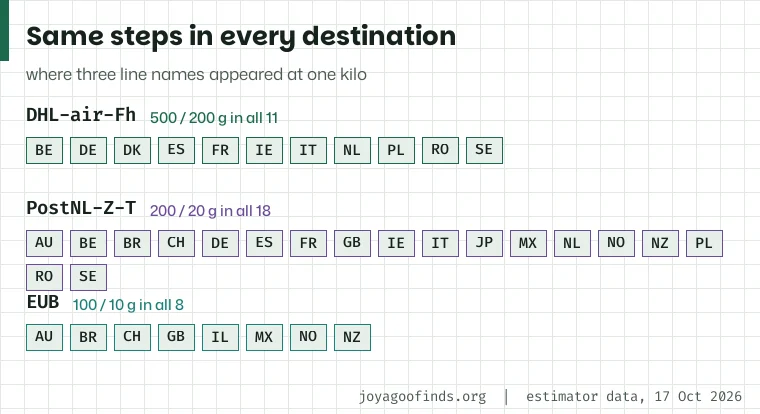
In this dated sample, each line name kept its step pair at the same queried weight across destinations. We compared every line name and weight that appeared in more than one destination, 248 such cells in all, and found no case where the pair or the billable weight differed by country.
So the grid belongs to the line, not to where the parcel is going. DHL-air-Fh is 500 / 200 whether it is heading to Ireland or Romania; PostNL-Z-T is 200 / 20 in all eighteen destinations that list it.
That makes the tables on this site portable: find your line name, and the table is a useful starting point for the same sampled line and weight. Recheck the current destination quote and size rule before paying.
Which pairs each destination sees
Destinations do differ in which lines they list, and so in which pairs are on offer. The matrix shows, for each of the 22 destinations we queried at one kilo, how many line names fall in each pair.
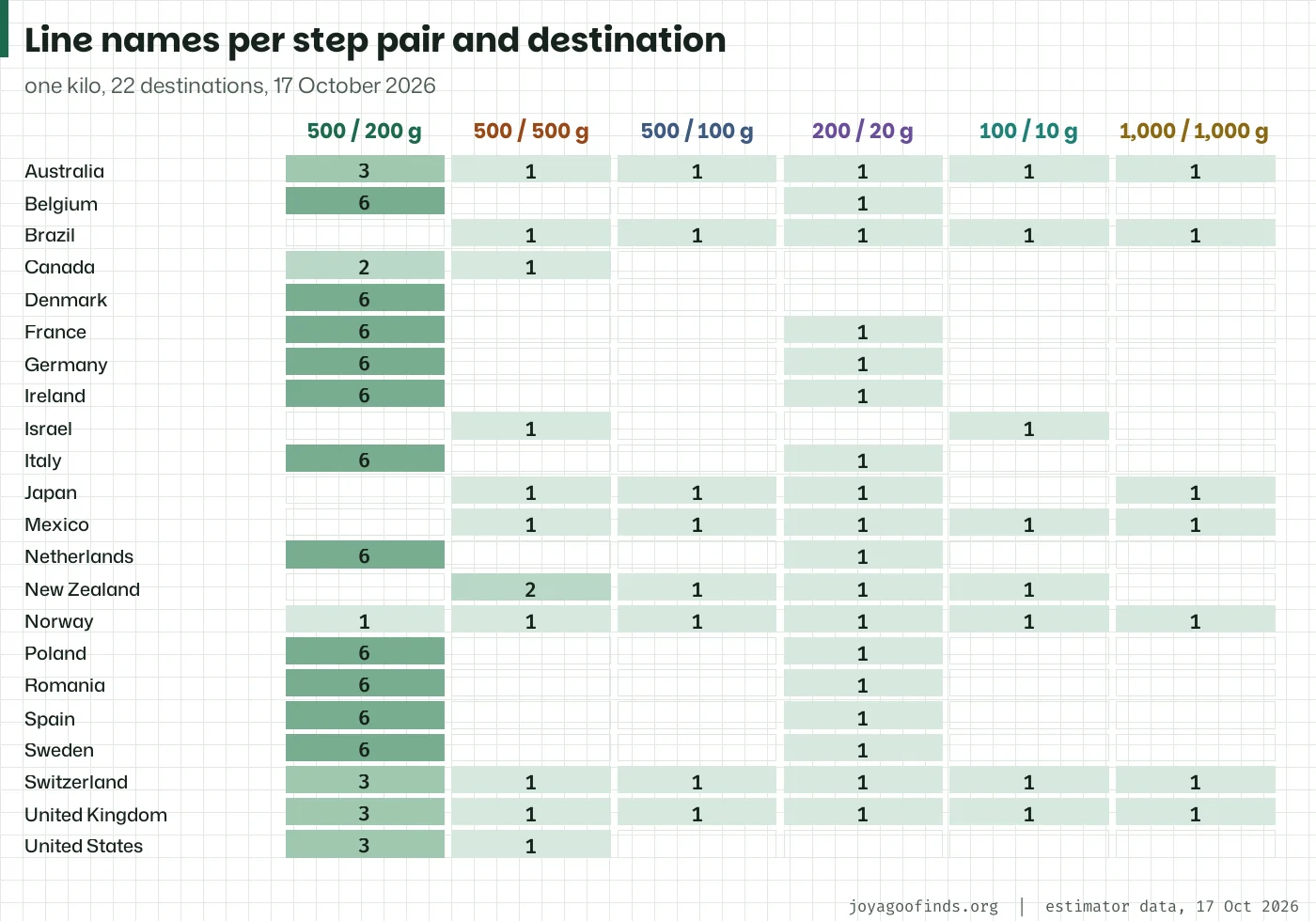
Three patterns stand out. Eleven European Union destinations see only the six DHL air lines plus, in ten of them, PostNL-Z-T, so their choice is between the common pair and the twenty-gram pair. The United States sees three lines on the common pair and EMS-US on half-kilo steps. Israel saw just two lines, EMS-40 and EUB.
Denmark listed only the DHL lines; Australia, the United Kingdom, Switzerland and Norway saw lines from every pair. None of this ranks the destinations or the lines, and the matrix says nothing about price or speed.