
The JoyaGoo Spreadsheet catalogue, shelf by shelf
Sixteen shelves of the product catalogue that goes with this guide, what a JoyaGoo Spreadsheet actually is, and how to tell a catalogue that is looked after from one that was left to rot.
The full shelf list for the catalogue
Fifteen shelves are category pages and one is a search, because women's clothing has no single category of its own there. Pictures are cropped from listings on those shelves; prices and stock live on the shelf itself.
 HoodiesCategory page
 JeansCategory page
 SneakersCategory page
 OuterwearCategory page
 SweatpantsCategory page
 T-shirtsCategory page
 WomenswearKeyword search
 BagsCategory page
 HatsCategory page
 JewelleryCategory page
 Sports jerseysCategory
 BeltsCategory
 EyewearCategory
 PerfumeCategory
 WatchesCategory
 ElectronicsCategory
What a JoyaGoo Spreadsheet is, in practice
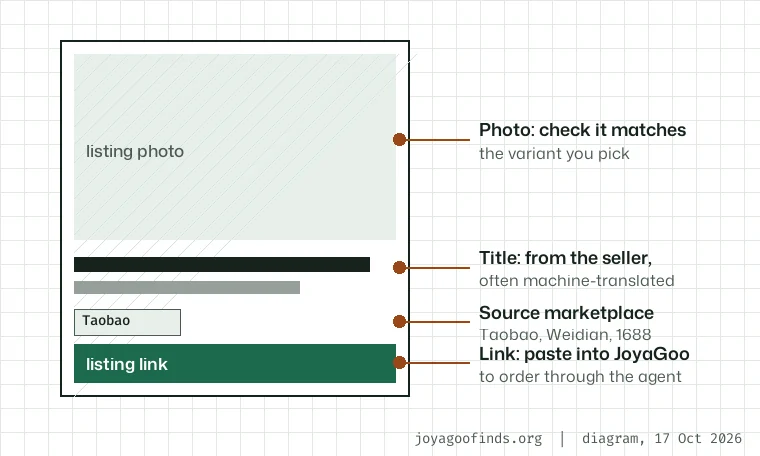
A JoyaGoo Spreadsheet is a product catalogue: shelves of cards, each one a find from Taobao, Weidian, 1688 or a similar marketplace, with a photo, a title, and the link back to the marketplace listing. You browse by category, open a card, and take its link to JoyaGoo.
JoyaGoo is the agent that turns that link into an order. It buys the item from the seller, has it posted to its warehouse in mainland China, photographs it on arrival, and holds it until you put it in a parcel. The catalogue chooses what; the agent handles how.
Neither the catalogue nor this site sells anything. The cards do not carry stock or shipping costs, and a card is only as current as the listing behind it. Treat each one as a lead to check, not a promise.
How a shelf hands you to a product page
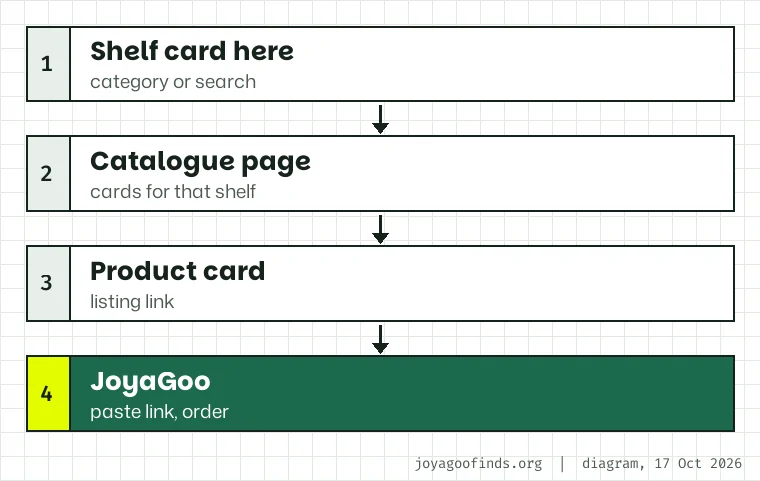
Fifteen of the sixteen shelves open a category page; the women's shelf opens a search, because that catalogue keeps women's clothing spread across other categories. Either way you land on a page of cards, and from a card you reach the original marketplace listing.
The search field near the top of each page here works the same way: type what you are after (a fleece hoodie, court shoes, a duffel bag) and you get the matching cards. Links from this site carry a tag that tells the catalogue the visit came from here; nothing else is passed along.
Once you have a listing you like, the weight question starts. Many listings print a gram weight in the specifications. Write it down as a planning input. The finder needs expected packed parcel weight, including other items and packaging, rather than a listing’s item weight alone.
Choose the option before you estimate its weight
A product URL may contain different sizes, materials or bundles. Select the exact version and quantity before recording the price and any weight information. Check whether a stated weight describes the item or a packaged shipment. Keep the measurements and included accessories with the seller link; a common stock photo cannot establish that two offers are equivalent.
The Spreadsheet is a discovery aid rather than an order or a shipping scale. JoyaGoo purchases the chosen product and records the warehouse arrival. Use that item’s information for later parcel planning, while recognising that protective packing adds its own dimensions and mass. A category example can explain a billing step, but it cannot predict the final packed weight of your particular purchase.
What this site keeps current, and how often
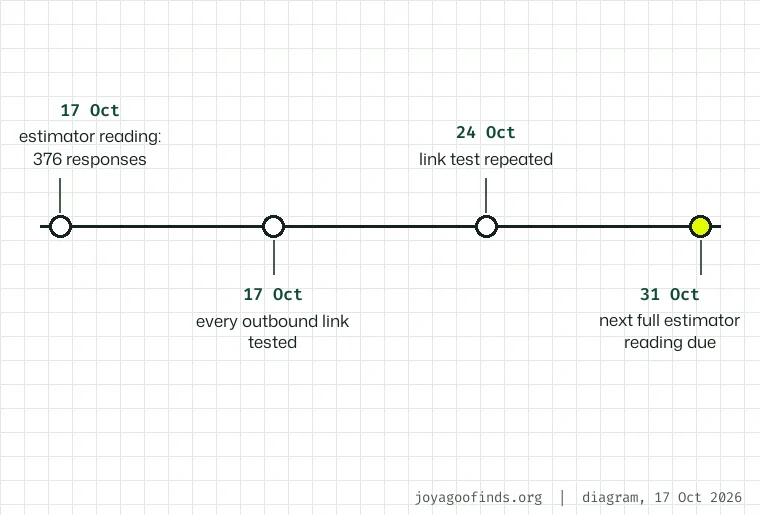
Why this site and not another list of finds? Because the part we maintain is measurable. Every billable weight here comes from a saved estimator response with a date on it, and every page says which reading it shows. If a number is older than fourteen days, it is due for a re-read.
Links get the same treatment. Outbound links to the catalogue and to JoyaGoo's help pages are tested before a page goes up, and the help-page links are opened in a real browser, because JoyaGoo's site answers every address with a page shell even when the article does not exist. A dead link here is a bug, and the footer address is where to report it.
What we do not keep current: shelves of the catalogue, prices, stock or promotions. Those change daily and are better read at the source.
Telling a looked-after spreadsheet site from an abandoned one
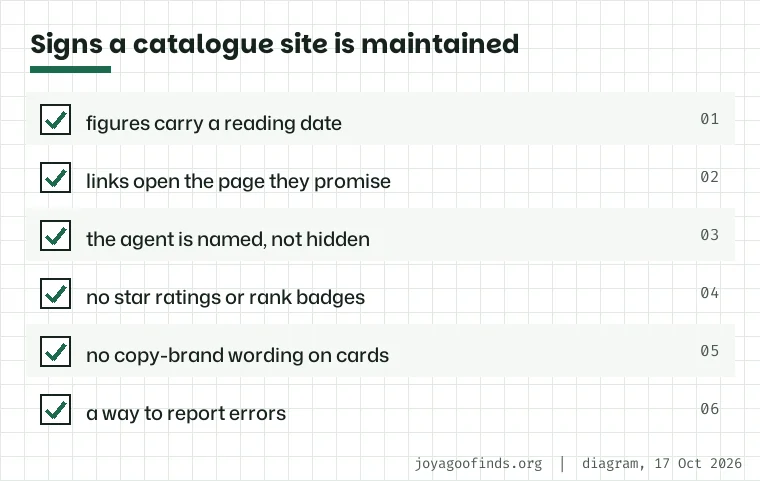
How to judge a spreadsheet site: look for evidence of upkeep. A maintained catalogue dates its numbers, tests its links and names the agent it works with. An abandoned one keeps cards for listings that vanished months ago and quotes fees the agent stopped charging.
Look for these signs: figures with a reading date beside them; links that open the page they describe; a named agent rather than vague talk of “the best”; no star ratings or rank badges standing in for evidence; no wording that sells copies of branded goods, which JoyaGoo itself forbids; and a working way to report an error.
Apply the same checks here. Every figure on this site has a date, the method page lists what we sampled and what we did not, and the footer address takes corrections.