
Whole kilos on the JoyaGoo grid, and the hundred grams added to them
On the common JoyaGoo step pair every billable weight is an odd number of hundreds, so a parcel that weighs a whole kilo is always billed a hundred grams more. Here is the pattern, its edges, and how the other pairs compare.
The odd-hundred ladder
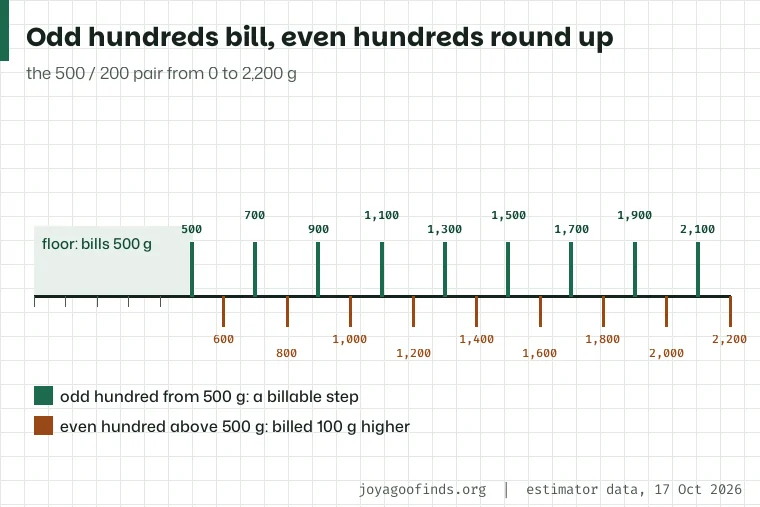
Start at a first weight of 500 g and add steps of 200 g: 700, 900, 1,100, 1,300, 1,500. Every billable weight the common pair can produce is an odd number of hundreds. Any parcel that weighs an even number of hundreds above 500 g therefore sits in the middle of a step and is billed at its top, exactly 100 g more.
Whole kilos are even hundreds, so they never escape: 1,000 g bills 1,100 g, 2,000 g bills 2,100 g, 5,000 g bills 5,100 g. The pattern does not fade with weight, because the step size never changes. At 20,000 g the common pair still adds 100 g.
On 81 of the 134 line listings we read at one kilo across 22 destinations, this is the pair in force. That is why the rounding to 1,100 g shows up so often in practice, even though only one of the six pairs produces it.
One kilo on each pair
Put the same 1,000 g parcel on each pair and only one of them moves it. The other five all have a step that ends exactly on one kilo, so the actual weight is already billable.
| Pair | Billable at 1,000 g | Added | Line names |
|---|---|---|---|
| 500 / 200 g | 1,100 | +100 | UK-RM-F, US-air-F, DHL-air-TM and 17 more |
| 500 / 500 g | 1,000 | +0 | EMS-60, DPEX-D-T, EMS-US, EMS-40 |
| 500 / 100 g | 1,000 | +0 | eEms |
| 200 / 20 g | 1,000 | +0 | PostNL-Z-T |
| 100 / 10 g | 1,000 | +0 | EUB |
| 1,000 / 1,000 g | 1,000 | +0 | CD-AIR |
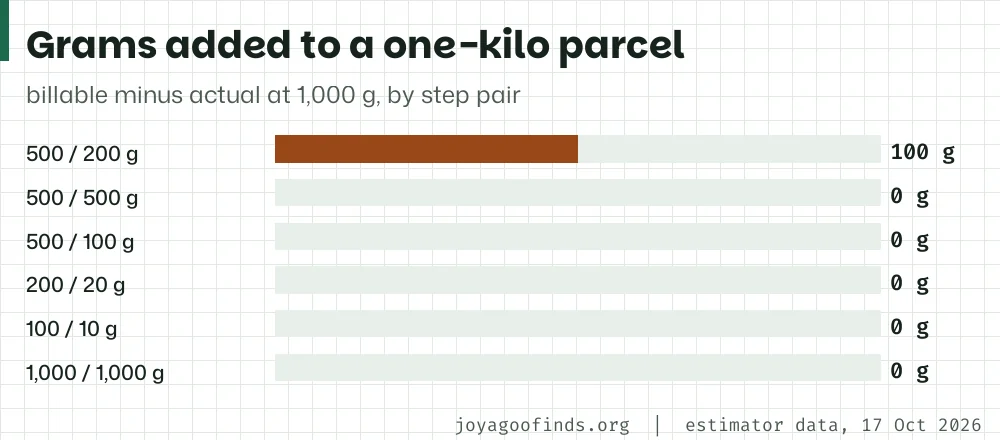
This is one example where the common pair adds weight while the other five base pairs do not. Move the parcel a little and the picture flips, as the next sections show: at 1,001 g the half-kilo and whole-kilo pairs add far more than 100 g.
A gram past the step
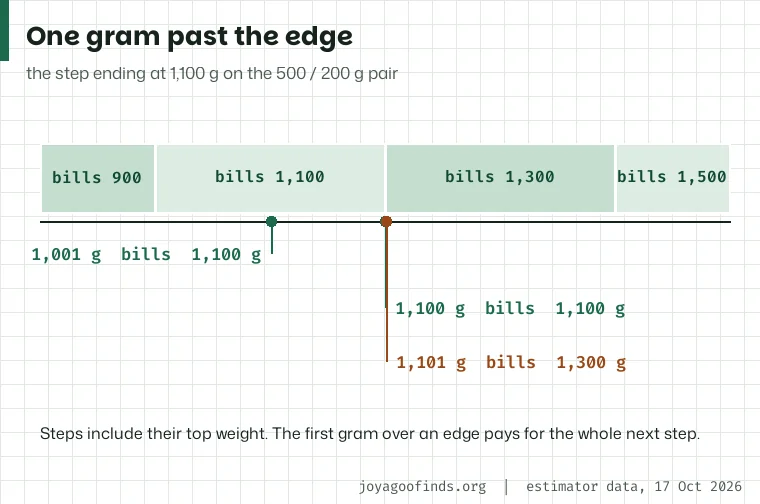
Steps include their top weight. On the common pair 1,100 g bills 1,100 g, and so does 1,001 g; 1,101 g is the first weight of the next step and bills 1,300 g. We checked this at every edge we sampled: 500 g stays at 500 g and 501 g moves to 700 g; 700 g stays at 700 g and 701 g moves to 900 g.
The same holds on every pair. 1,000 g bills 1,000 g on the half-kilo pair while 1,001 g bills 1,500 g; on CD-AIR, 1,001 g bills two kilos. A single gram over an edge always costs a whole step, never a fraction of one.
That is why the gram reading matters more than the kilo figure people tend to quote. 1,100 g and 1,101 g look the same to a person; on the common pair they bill 1,100 g and 1,300 g.
Heavier whole kilos on the same ladder
The added hundred does not grow or shrink with weight. Three common-pair lines show it at six whole kilos, up to where each one stops being priced:
| Actual | 500 / 200 rule | US-air-F | UK Line-MG | DHL-air-Fh |
|---|---|---|---|---|
| 1,000 g | 1,100 | 1,100 | 1,100 | 1,100 |
| 2,000 g | 2,100 | 2,100 | 2,100 | 2,100 |
| 3,000 g | 3,100 | 3,100 | 3,100 | 3,100 |
| 5,000 g | 5,100 | 5,100 | 5,100 | 5,100 |
| 10,000 g | 10,100 | no price | 10,100 | 10,100 |
| 20,000 g | 20,100 | no price | over limit | 20,100 |
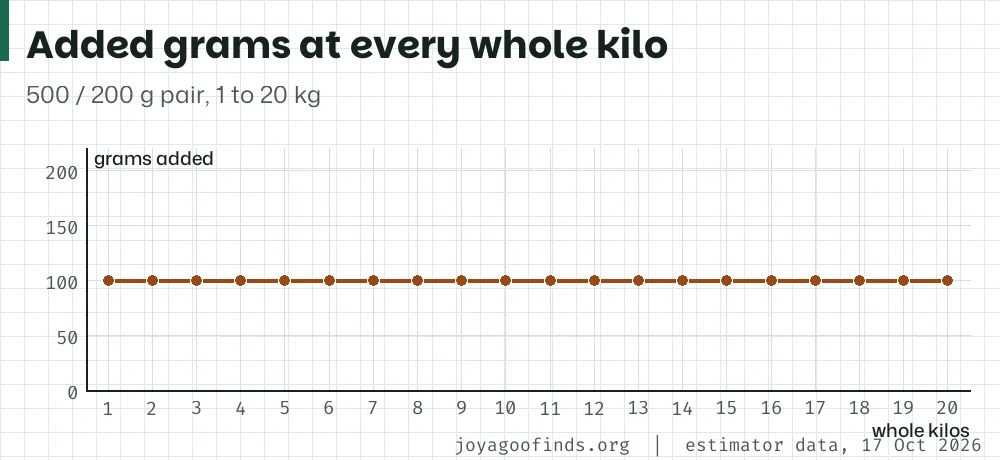
Two lines in the table stop early, for different reasons. US-air-F is not priced above 5,000 g even though its Detail panel states a weight range up to 20,000 g; UK Line-MG refuses anything over 15,000 g. Where a line is priced, the rule never deviates.
The same parcel, six different overshoots
Whole kilos flatter the coarse pairs, because every one of them has an edge at one kilo. Pick a weight that is not round and the order changes completely.
| Pair | Billable at 1,050 g | Added | Billable at 1,250 g | Added |
|---|---|---|---|---|
| 500 / 200 g | 1,100 | +50 | 1,300 | +50 |
| 500 / 500 g | 1,500 | +450 | 1,500 | +250 |
| 500 / 100 g | 1,100 | +50 | 1,300 | +50 |
| 200 / 20 g | 1,060 | +10 | 1,260 | +10 |
| 100 / 10 g | 1,050 | +0 | 1,250 | +0 |
| 1,000 / 1,000 g | 2,000 | +950 | 2,000 | +750 |
| CA-air-P above 1,000 g | 1,500 | +450 | 1,500 | +250 |
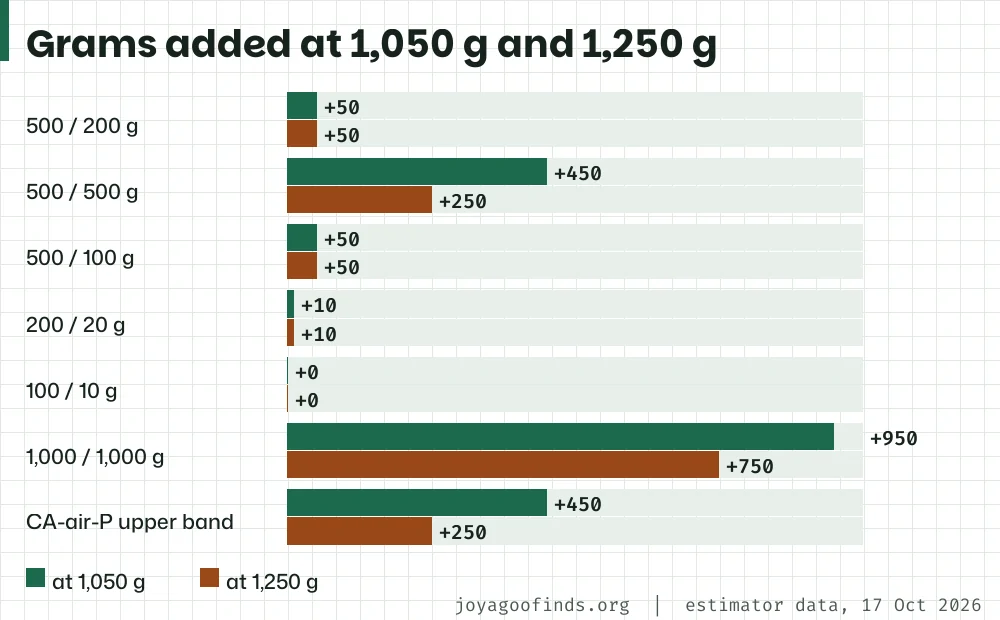
At 1,050 g the common pair adds 50 g, the half-kilo pair 450 g and the whole-kilo pair 950 g. The fine pairs barely notice: 10 g on the twenty-gram pair, nothing on the ten-gram pair. No pair is always gentle; each one has weights where it rounds hard and weights where it does not round at all.
Reading the ladder without a price
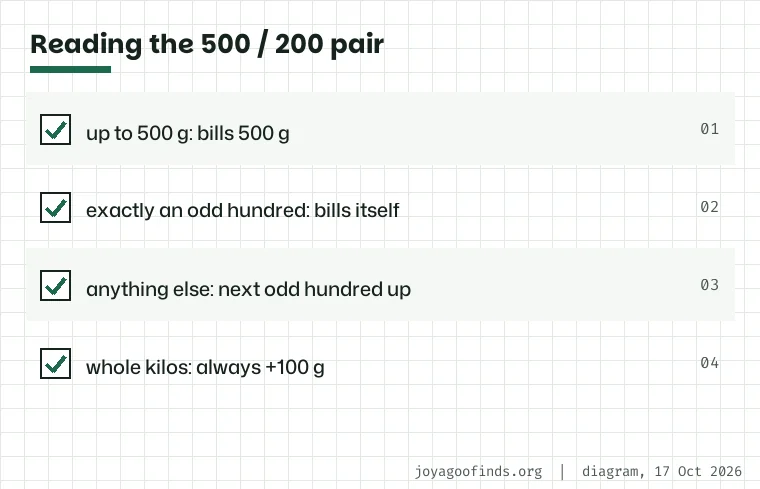
For the common pair you can do the reading in your head. Up to 500 g, the answer is 500 g. If the weight is exactly an odd number of hundreds, it bills itself. Anything else rounds up to the next odd hundred: 840 g becomes 900 g, 1,180 g becomes 1,300 g, 1,960 g becomes 2,100 g.
None of this needs a price, and that is deliberate. Prices on the estimator change with the market and with promotions; the step calculation here remains tied to the published 17 October snapshot; a carrier can change its rules. Knowing that a parcel will bill 1,100 g rather than 1,000 g lets you read the official quote correctly instead of wondering why it looks high.
For the other pairs, and for weights you would rather not work out, the grid position finder does the same reading for all 28 line names at once.