
JoyaGoo as a shopping agent, read through its weight steps
Who runs JoyaGoo, what it does between your order and your parcel, why people pick it, and the situations that call for another agent. Written by an independent site that reads JoyaGoo's public data.
What JoyaGoo is
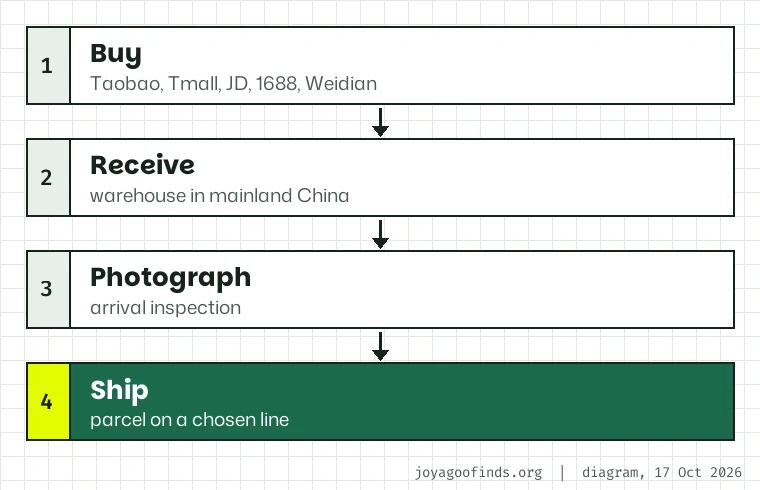
JoyaGoo is a shopping agent: a company that buys from Chinese marketplaces on behalf of buyers abroad. You paste a listing link (or search) on joyagoo.com, pay for the item and the seller's domestic postage, and JoyaGoo places the order, has the goods delivered to its warehouse in mainland China, photographs them on arrival and stores them until you ship.
It takes links from Weidian, Taobao, Tmall, 1688 and JD, and runs its help centre in ten languages. Its fee explanation says the buying service itself is free; the full bill can still include goods, domestic postage, freight, fixed parcel charges, optional extras, currency conversion and destination charges.
The international shipping is where this site comes in: it is billed on the shipping line you pick, at a weight rounded by that line's step pair.
Who operates the site
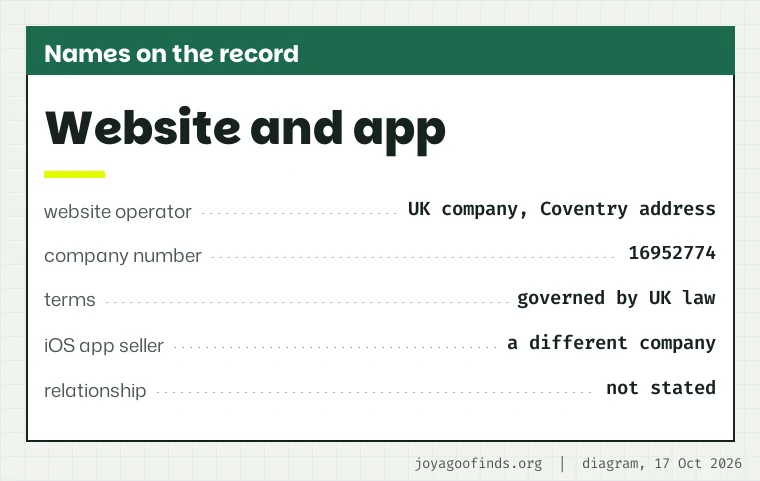
According to the official Contact Us page, the website belongs to a firm registered in England at a Coventry address (AMBERLEIGH TECH LIMITED, registration 16952774). The terms of service name UK law as the law that applies.
On the App Store the iOS app carries another seller name, GLOBAL JIAYI TRADING GROUP LIMITED, with a first release on 18 April 2025. Nothing on JoyaGoo's pages explains how the two companies are connected, and this site does not guess.
Support questions go to [email protected] or to the chat window on joyagoo.com or inside the app. The warehouse is somewhere in mainland China; we leave the city out, because official pages contradict each other on it.
The name change
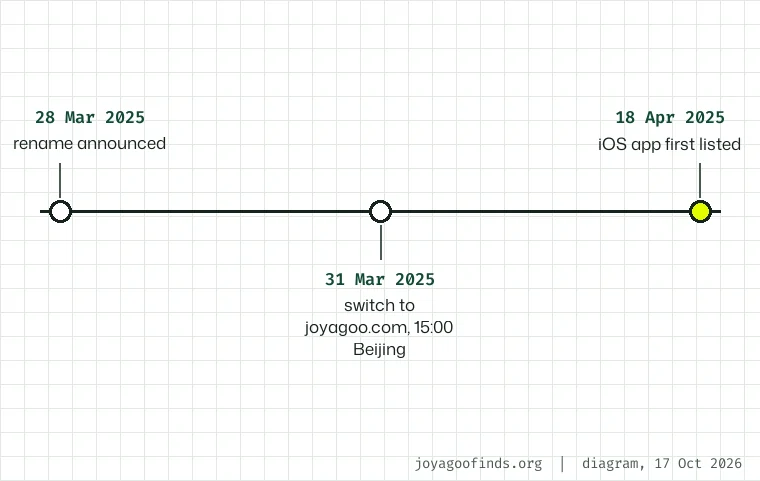
The service ran as JoyaBuy until 31 March 2025; the switch came at 15:00, Beijing time. From that moment joyagoo.com took over, product links that pointed at the old domain went dead, and existing accounts kept their order history and member perks (rename notice).
For catalogue users the practical effect was on links: the notice asked anyone keeping a list of finds to switch every link to the new domain. A catalogue card that still points at the old address is a link that needs checking before you rely on it.
Some help pages written before the switch still carry older wording. Where we cite one, we cite what it says about the service, and we note its last-modified date so you can judge its age.
Reasons to order through JoyaGoo, and reasons to look elsewhere
Why JoyaGoo? Start with what every shopping agent does: buy on your behalf, receive at a warehouse, photograph on arrival, store for a while and ship. JoyaGoo does all of that, and none of it sets it apart.
What is different is mostly about what it publishes. Its shipping estimator works without an account and returns every line's step pair, weight limits and size rules. That public data is the raw material for every table here. The estimator marks free insurance line by line; confirm the selected parcel’s eligibility and exclusions rather than relying on the broader homepage message. Its help pages carry modification dates, so you can tell a 2024 page from a 2026 one. And the buying service carries no fee.
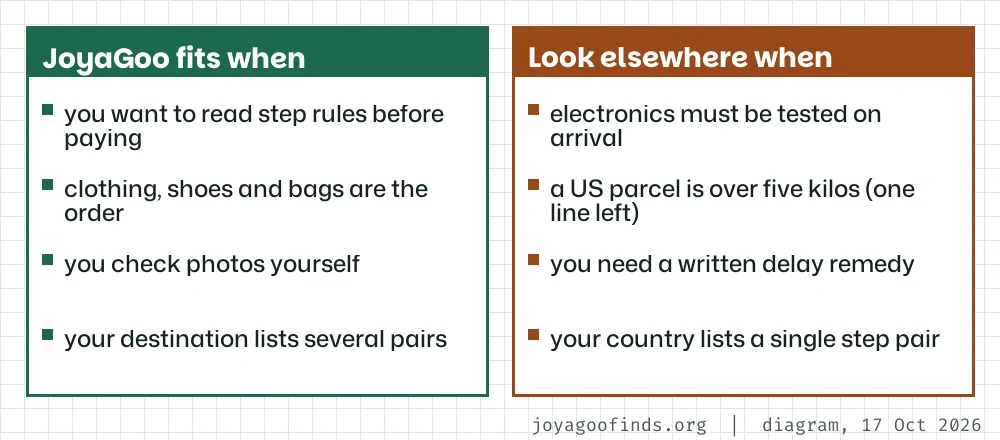
When should you use another agent? If you need electronics tested: JoyaGoo's arrival inspection covers appearance only and excludes power-on checks. If a heavy parcel is headed to the United States, note that US-air-F stopped being priced above 5,000 g in our reading. And if a written remedy for late delivery matters to you, JoyaGoo's terms only promise to negotiate with carriers, so compare that with what other agents put in writing.
Other agents shoppers compare it with
Catalogue communities talk about many agents besides JoyaGoo, among them Superbuy, CSSBuy, Sugargoo and Kakobuy. They run the same basic model and publish their own shipping rules, and their step pairs are their own business: nothing on this site describes how they round.
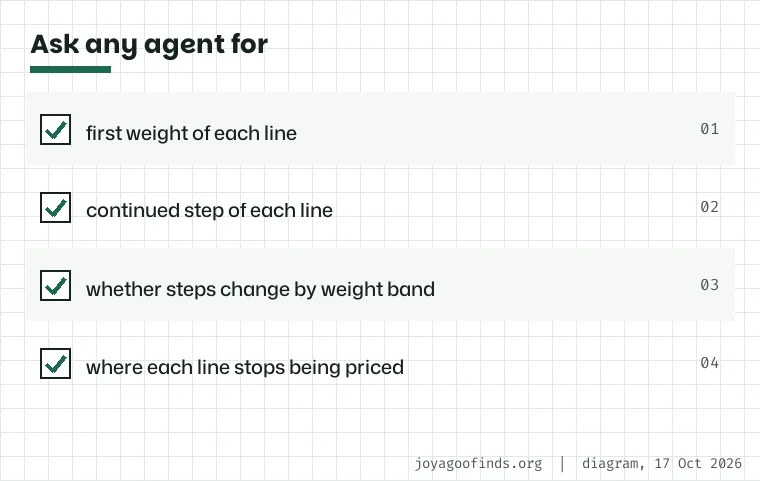
If you are comparing, the two numbers this site is built on are the ones to ask for: the first weight and the continued step of each line. Two agents quoting similar prices per kilo can bill the same parcel very differently once rounding is applied, as the whole-kilo comparison shows within JoyaGoo alone.
We do not rank agents, and we do not suggest one over another. The comparison that matters is the one you make with your own parcel weight and destination.
JoyaGoo's line on counterfeit goods
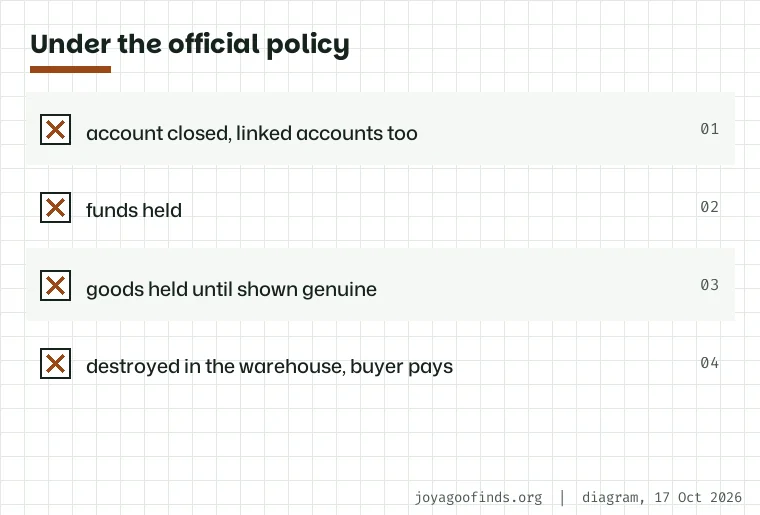
Counterfeit purchases are off the table at JoyaGoo. The rule has its own help article (JoyaGoo Anti-Counterfeiting Policy), and the consequences it lists are blunt: a closed account, with linked accounts closed too, frozen funds, parcels held back until the goods are proven genuine, and fakes destroyed at the warehouse at the buyer's expense.
Its prohibited items statement lists counterfeit and pirated goods among the things it will not handle. Separately, JoyaGoo states that it cannot vouch for the quality or authenticity of goods sold by third-party sellers. That is a limit on what it checks, not permission: the ban applies regardless.
This site follows the same line. The catalogue shelves we link to are general clothing and accessory categories, and nothing here helps anyone buy copies of branded goods.