
Changing steps: four JoyaGoo lines that switch pairs by weight
Two Canadian air lines and two Swiss DPD lines use different step pairs in different weight bands. On the Canadian pair that creates a jump of four hundred grams between one kilo and one gram more.
Three bands on CA-air-P
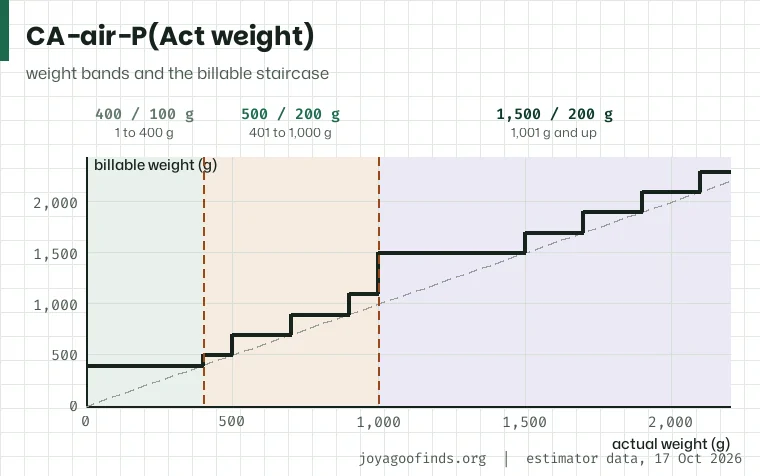
CA-air-P(Act weight) changes its step pair twice. The estimator's data fields for first and continued weight carry different values depending on the weight you enter, and the billable weights follow:
| Weight band | Pair (g) | Billable weights |
|---|---|---|
| 1 to 400 g | 400 / 100 | 400 at every weight |
| 401 to 1,000 g | 500 / 200 | 500, 700, 900, 1,100 |
| 1,001 g and up | 1,500 / 200 | 1,500, 1,700, 1,900 ... |
We pinned the edges by querying 399 g, 400 g, 401 g, 1,000 g and 1,001 g: the pair changes between 400 g and 401 g and again between 1,000 g and 1,001 g. The band edges did not vary between the queries.
Three bands on CA-air-MG
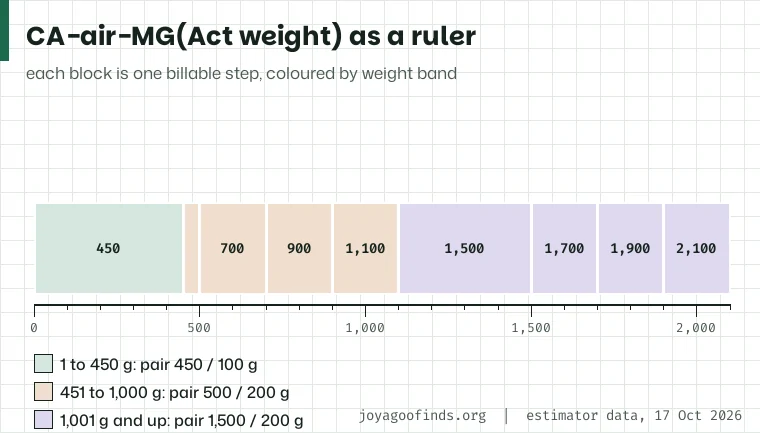
CA-air-MG(Act weight) has the same three-band shape with one difference: its lowest band runs to 450 g and bills 450 g. From 451 g to 1,000 g it uses the common pair; from 1,001 g it restarts at a first weight of 1,500 g with 200 g steps.
Both Canadian lines are named with an “(Act weight)” suffix while their own rule sentence describes billing the larger of actual and size-based weight. We note the mismatch once and leave it there; this site reads only the weight steps.
Above one kilo the two lines are indistinguishable on the grid: same band edge, same 1,500 g first weight, same 200 g steps all the way to their 28,000 g limit.
The shelf between one kilo and fifteen hundred grams
The upper band is where the Canadian lines part company with every other line on the common pair. On an ordinary 500 / 200 line, weights from 1,001 g to 1,500 g spread over three steps. On the Canadian lines they all land on one.
| Actual weight | Ordinary 500 / 200 line | CA-air-P or CA-air-MG |
|---|---|---|
| 1,000 g | 1,100 | 1,100 |
| 1,001 g | 1,100 | 1,500 |
| 1,100 g | 1,100 | 1,500 |
| 1,101 g | 1,300 | 1,500 |
| 1,300 g | 1,300 | 1,500 |
| 1,301 g | 1,500 | 1,500 |
| 1,500 g | 1,500 | 1,500 |
| 1,501 g | 1,700 | 1,700 |
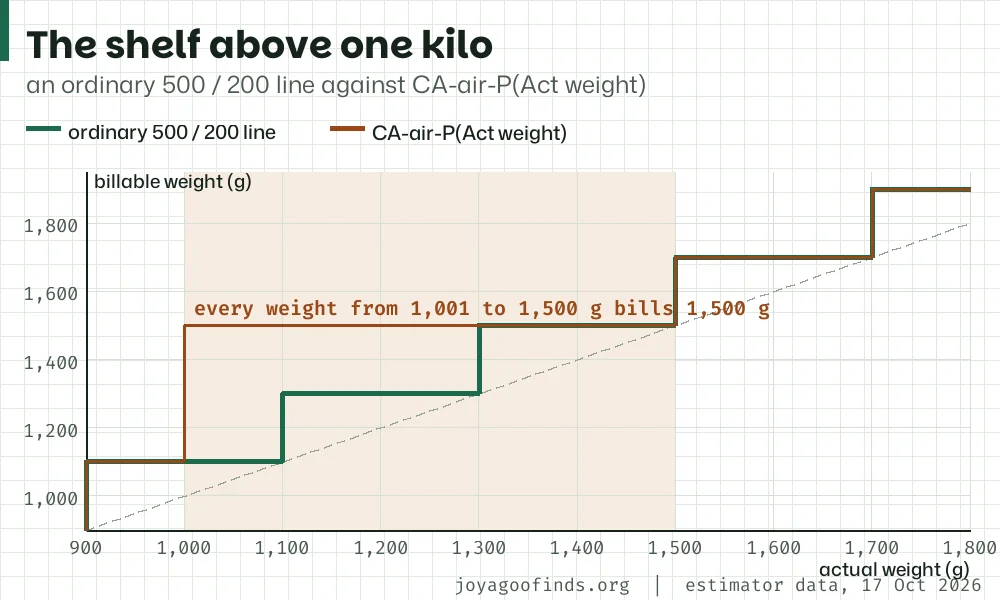
At 1,000 g the two agree on 1,100 g. One gram later the Canadian lines bill 1,500 g, and they stay there until 1,500 g. From 1,501 g onward the two meet again, because 1,500 g plus steps of 200 g lands on the same odd hundreds as the common pair.
Two bands on the Swiss DPD lines, with no visible jump
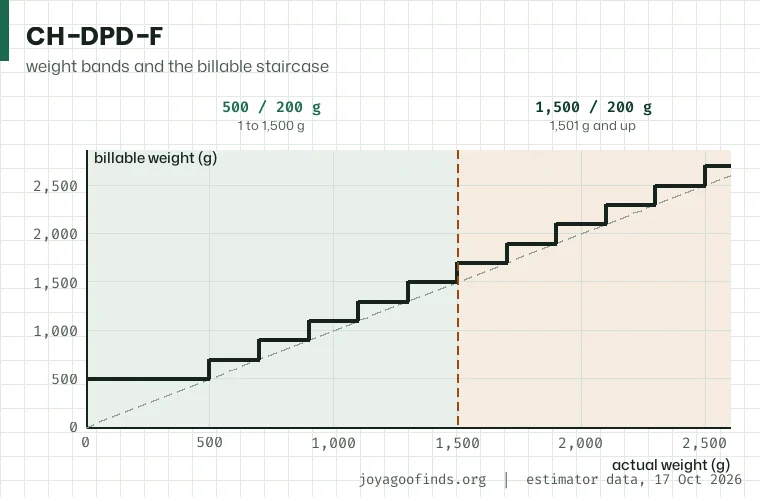
CH-DPD-F and CH-DPD-P also change pair: 500 / 200 up to 1,500 g, then 1,500 / 200 from 1,501 g. Unlike the Canadian lines, their switch happens on a step edge. 1,500 g is already a billable weight of the common pair, so the new band starts exactly where the old staircase would have gone next.
The billable weights are identical to an ordinary common-pair line: 1,499 g bills 1,500 g, 1,501 g bills 1,700 g, 2,000 g bills 2,100 g. Only the Detail panel gives the change away, by printing a first weight of 1,500 g once you pass 1,500 g.
Both Swiss lines stop at 5,000 g. Above it the estimator returned them marked unavailable with “Package weight can't exceed 5,000g”.
Where each staircase ends
Every line has a stated weight limit, shown in its Detail panel as a weight restriction, and most were priced right up to the highest weight we sampled below that limit. The chart shows the priced range we observed for each line name.
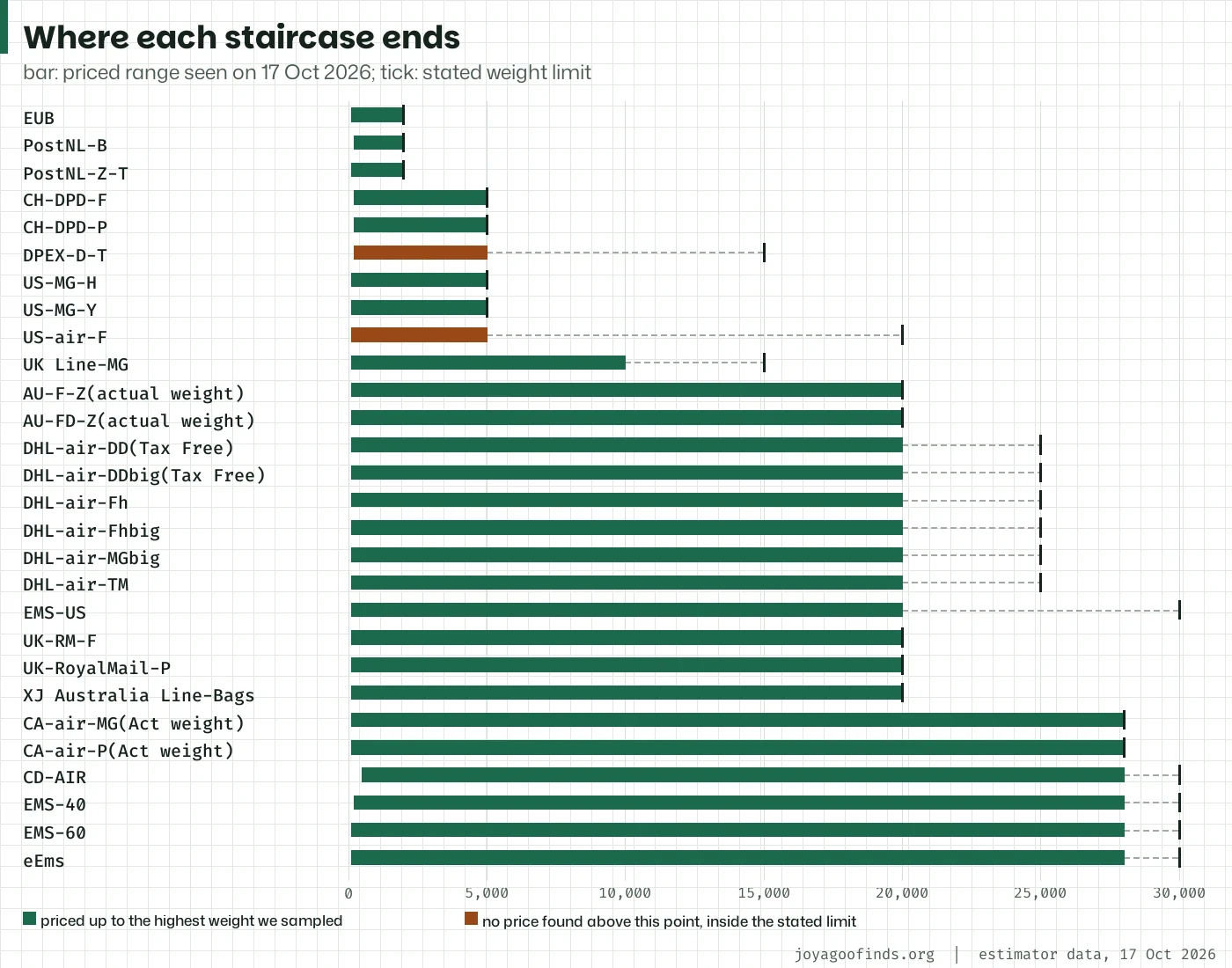
Three groups emerge. EUB, PostNL-Z-T and PostNL-B stop at 2,000 g. The Swiss DPD lines, US-MG-Y and US-MG-H stop at 5,000 g. The DHL air lines, the Australian lines, the EMS lines, eEms and CD-AIR run far beyond anything a typical catalogue parcel weighs.
Weights the estimator will not price
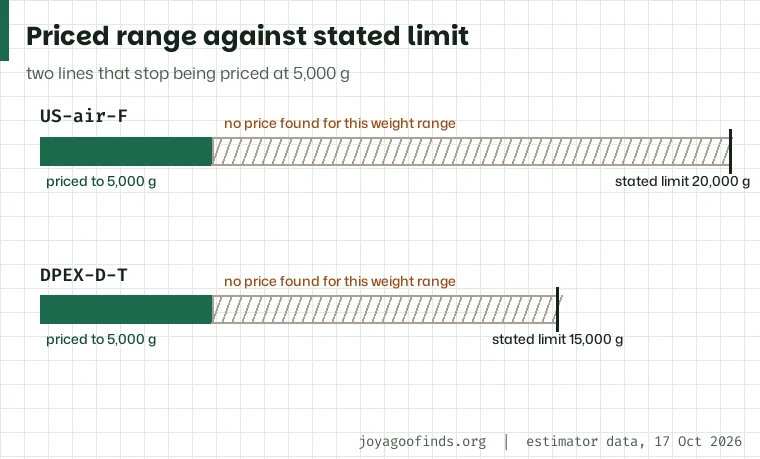
Two lines stop being priced long before their stated limit. US-air-F was priced at 5,000 g, where it billed 5,100 g, and refused from 5,001 g with the message that no price was found for this weight range. Its Detail panel, meanwhile, states a weight restriction of 0g to 20000g.
DPEX-D-T behaved the same way: priced at 5,000 g, unpriced from 5,001 g, with a stated limit of 15,000 g. We sampled 5,001 g, 5,500 g, 6,000 g, 8,000 g, 9,999 g and several weights in between to find the edge.
Neither case says anything about whether the line could carry a heavier parcel; it only says the estimator had no price for it on 17 October 2026. If your parcel is heavier than 5,000 g, read the estimator's answer, not the stated limit.