
Grid position finder: one actual weight, every step pair
Enter what the parcel weighs. The finder shows the billable weight on every JoyaGoo step pair, the grams the rounding adds, and the room left before the next step. No prices, no sizes.
Enter an actual weight
Use the gram figure you expect for the packed parcel. The finder accepts 1 to 30,000 g and answers instantly; the example buttons load weights that show the interesting cases.
Reading what the finder prints
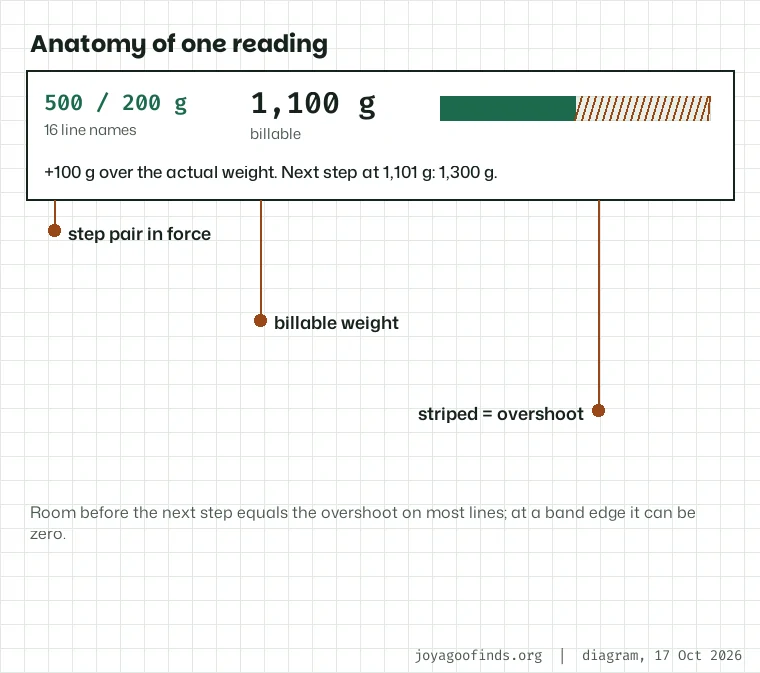
How to use the tool, part by part. Each reading starts with the step pair in force at your weight and how many line names share it. Line names that sit in the same pair but behave differently at your weight, such as the Canadian lines at the edge of a band, get a reading of their own.
The middle figure is the snapshot rule’s calculated billable weight, assuming actual weight governs and the line remains available. The bar spans the step your weight falls into: green up to your actual weight, striped from there to the billable weight. The striped part is the overshoot, the grams you pay for but do not send.
The sentence under the bar gives the room before the next step and what that next step bills. On most lines the room equals the overshoot. On the Canadian air lines at exactly 1,000 g it is zero, because one more gram moves the parcel into a new band.
Lines that the estimator does not price at your weight are listed under the readings with the reason: over the line's weight limit, below its first priced weight, or a weight range with no price.
Worked readings at five weights
Five weights run through one line from each pair, plus the Canadian line that changes bands. Read across to see the same parcel billed seven ways; read down to see one staircase climb. CD-AIR is not priced below 501 g.
| Actual | US-air-F | CA-air-P | EMS-US | eEms | PostNL-Z-T | EUB | CD-AIR |
|---|---|---|---|---|---|---|---|
| 300 g | 500 | 400 | 500 | 500 | 300 | 300 | not priced |
| 1,000 g | 1,100 | 1,100 | 1,000 | 1,000 | 1,000 | 1,000 | 1,000 |
| 1,001 g | 1,100 | 1,500 | 1,500 | 1,100 | 1,020 | 1,010 | 2,000 |
| 1,250 g | 1,300 | 1,500 | 1,500 | 1,300 | 1,260 | 1,250 | 2,000 |
| 2,000 g | 2,100 | 2,100 | 2,000 | 2,000 | 2,000 | 2,000 | 2,000 |
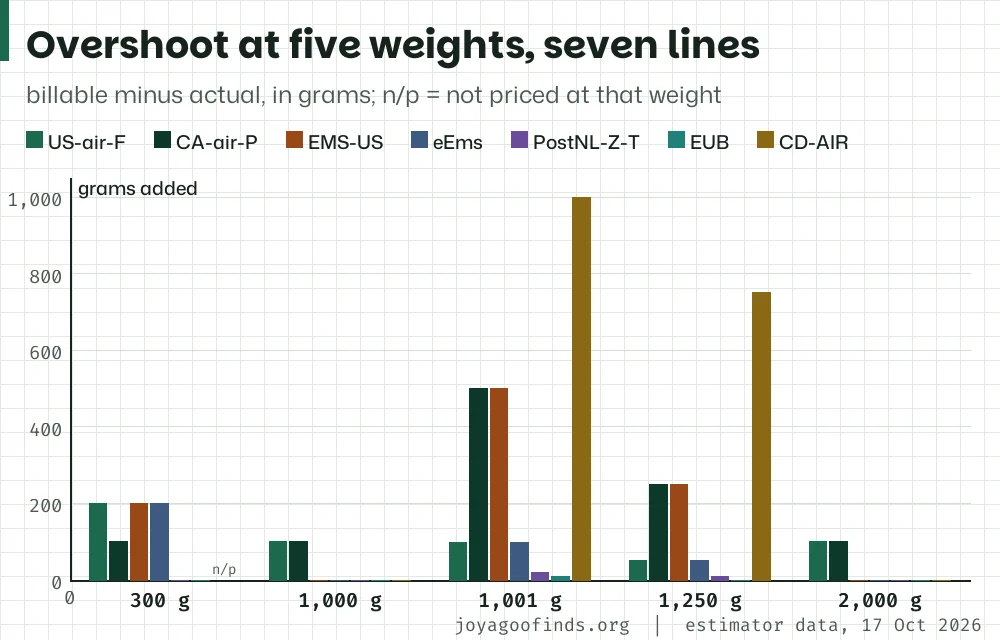
Two readings stand out. At 1,001 g the half-kilo and whole-kilo pairs jump a full step while the common pair barely moves, and the Canadian line leaps to 1,500 g. At 2,000 g the common pair adds exactly 100 g, as it does at every even hundred above 500 g.
What the finder leaves out on purpose
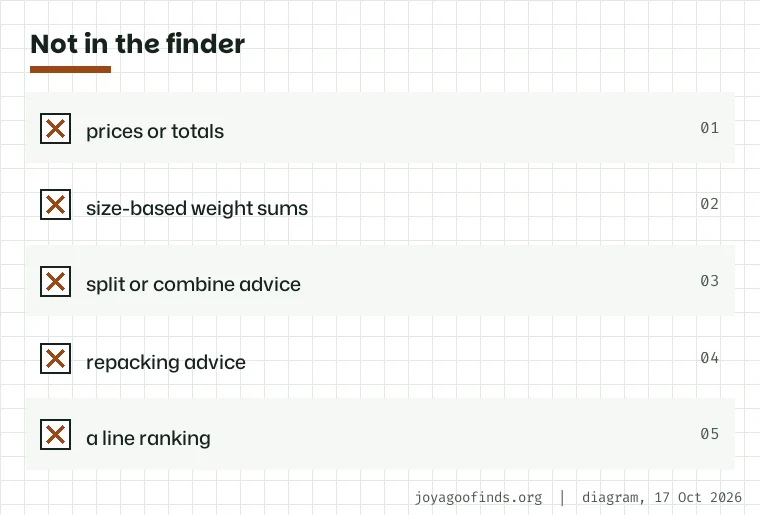
No prices. Prices move weekly and depend on coupons and display currency; the step a weight lands on is far steadier. If you want a price, the official estimator gives one in seconds.
No size-based sums. Many lines bill the larger of actual and size-based weight, with divisors and side-length triggers that differ by line. Ticking the rules box shows each line's own sentence, so you know when size may take over, but the arithmetic stays on the official page where the dimensions go in.
No advice on splitting, combining or repacking parcels. Removing packaging can cost you the right to return an item, and the trade-offs depend on fixed charges this site does not show. And no ranking: the readings always appear in the same order, whatever the weight.
How the finder was checked against the estimator
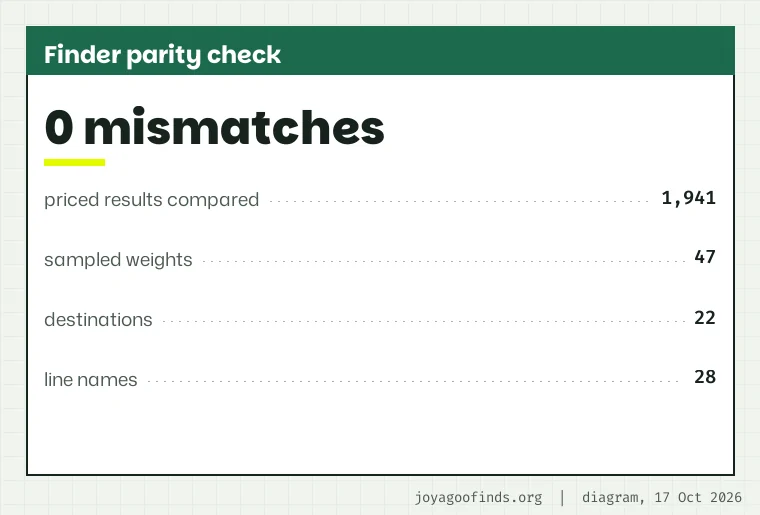
The finder uses one rule: a weight at or below the first weight bills the first weight; above it, every started continued step counts in full. Bands only change which pair applies. We tested that rule against all 1,941 priced line results in the saved responses, and every billable weight matched.
The page itself was tested too. A script loads the finder in a browser, types a long list of weights including every band edge, reads each result and compares it with figures computed separately in Python. The result file sits with the other verification records.
What the test cannot cover is a weight we never sampled. Between our sampled weights a line could, in principle, change pair. The method page lists the 47 weights we read, so you can see where the gaps are.